Troubleshooting
Pressure that will not settle: check valve, seal, or neither
August 9, 2026
When an HPLC pump will not hold steady pressure, three parts usually get replaced. Check valves, plunger seals, and the inlet valve. Usually in that order, and usually before anyone knows which one is the problem.
There is a test that costs nothing, takes about 5 minutes, and tells you whether a check valve is involved. Do that one first.
What steady actually means
Published figures vary, because different sources measure ripple differently. A pump working correctly is usually quoted as holding pressure to within about 2 percent. Research grade systems are quoted under 1 percent, with 0.2 percent common. Some specifications are written as under 5 percent peak to peak.
Treat those as a range rather than a limit. The number that actually helps you is your own. Write down the pressure and the size of the ripple when the pump is known to be good, and keep it with the instrument log. A pump that used to run at 1 percent and now runs at 4 percent has changed, even though 4 percent is still inside some published specifications.
Four shapes worth recognizing
Shape B is the one people get wrong most often. A regular swing that follows the pump stroke is mechanical. The cause is a valve rather than the mobile phase.
The free test, before you buy anything
Most check valve problems are the inlet valve. The outlet valve is usually protected by a filter, so it stays cleaner for longer.
To find out whether the inlet valve is the problem:
- Put the solvent bottle at the same height as the pump.
- Introduce a small air bubble into the intake line.
- Run the pump under pressure and watch the bubble.
If the bubble travels steadily towards the pump and never goes backwards, both valves are sealing. If it moves back and forth with each pump stroke, the inlet valve is stuck or blocked. You have your answer without opening anything.
Before that, rule out air. Excessive ripple is usually a degassing problem rather than a broken part. A new cartridge cannot fix a mobile phase that was never degassed.
If it is the check valve, clean it before you replace it
Check valves seal by pressing a polished sapphire, ruby or ceramic ball onto a matching seat. These surfaces stick together if they dry out. The effect is worst when acetonitrile was the last solvent in the pump. That is a stuck valve rather than a worn one, and it can often be recovered.
Take the cartridge out, put it in a small beaker of methanol or isopropanol, and sonicate it for 10 to 15 minutes. A stuck ball can sometimes be freed by tapping the cartridge on the bench.
Cleaning is also a test. If sonication fixes the fault and it comes back within a few weeks, the cartridge is worn, and a new one is the right purchase.
If it is the seal
A worn plunger seal leaks, and the signs are visible before the pressure trace gets bad. Look for liquid or a salt crust around the pump head, an unstable baseline, retention times that move, and a maximum pressure lower than before.
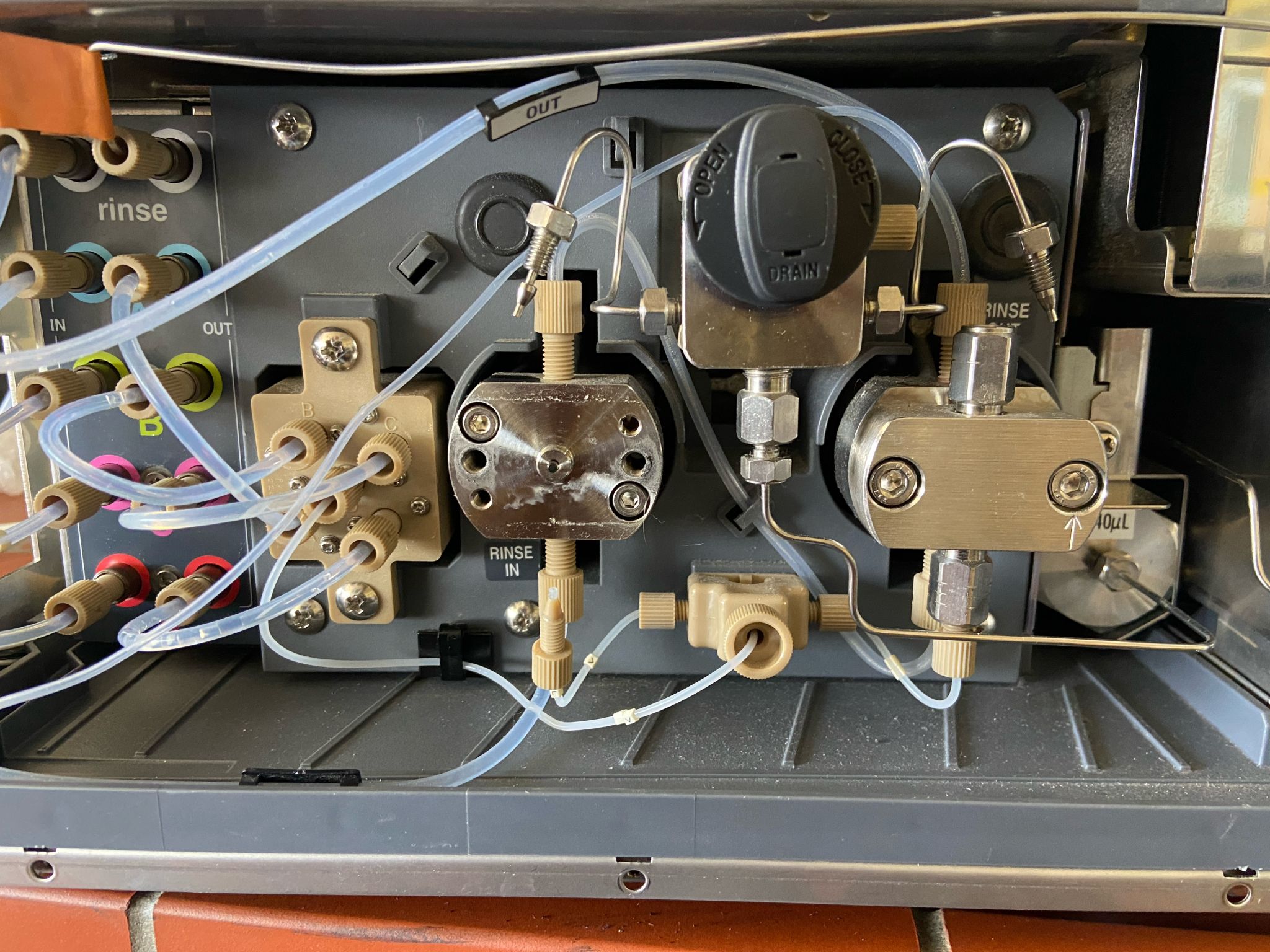
Piston seals are generally changed every 6 months or about every 1,000 hours of use. In a dual piston head, change both at the same time. One fresh seal working against one worn one gives you an unbalanced pump and a second job in a few weeks.
If you run buffers, flush the salts out before the system sits idle. Dried buffer on the plunger is abrasive, and it is the most common reason a seal fails early.
Check the plunger before you fit the new seal
This step decides whether you do the job once or twice.
Take the plunger out and look along it with a 10x magnifier. You are looking for scratches running lengthwise, flat spots, or glazed areas. Any of those will destroy a new seal quickly. The seal presses against the plunger while the plunger moves, so a damaged plunger wears the seal fast.
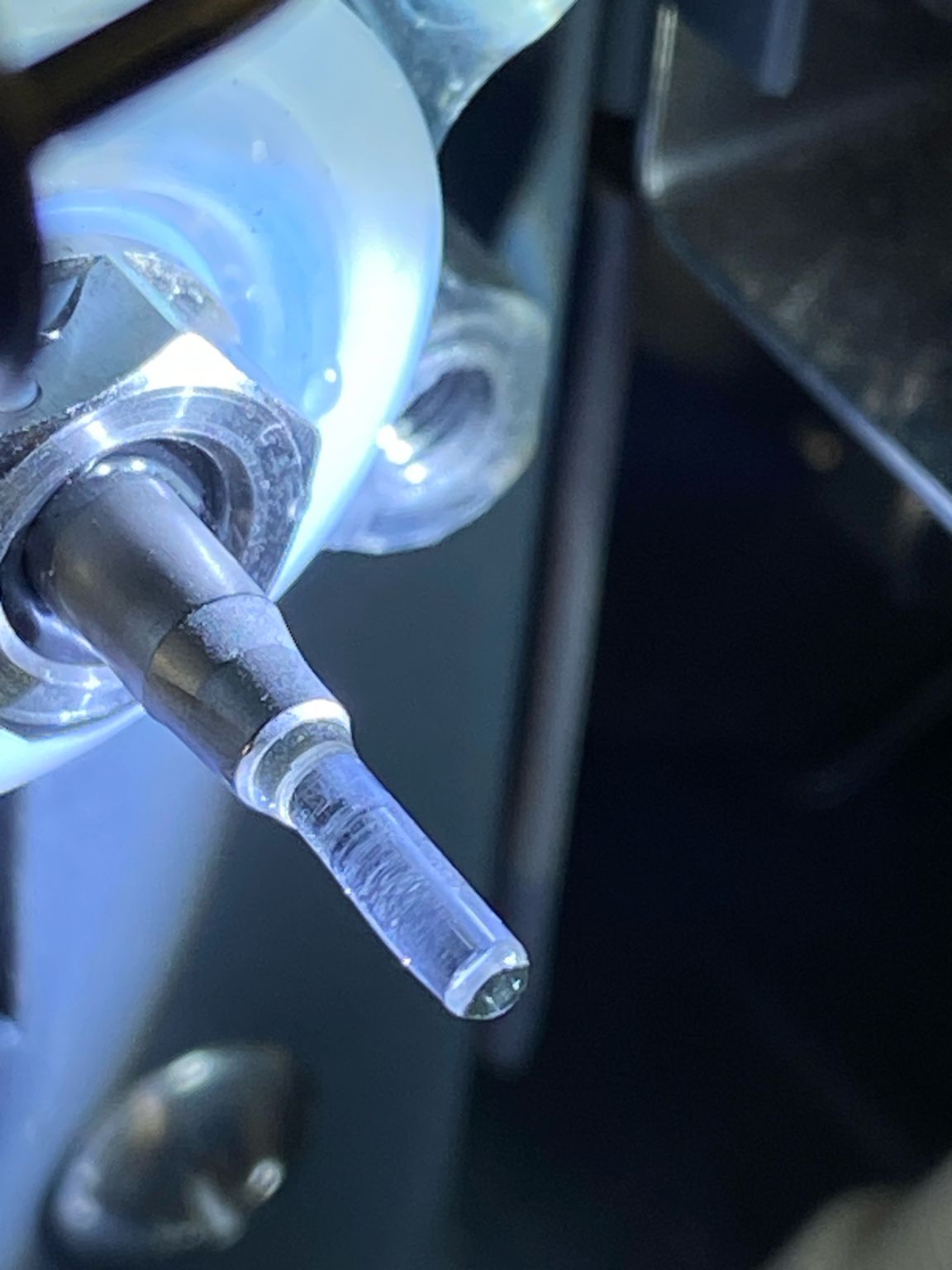
The plunger above is a fair example of the glazed case. There are no deep gouges to point at. The surface has simply gone dull where it runs through the seal, and that dull band is enough to chew through a new seal.
A scored plunger is why a pump comes back 3 weeks after a seal change with the same leak. The seal was fine. It was fitted against a plunger that destroys seals.
So if the pump runs buffers often, order the plunger together with the seal, or at least inspect the plunger before you start the repair.
The active inlet valve fails differently
An active inlet valve is a different part from a passive check valve, and it fails differently. A bad cartridge makes the pump overpressurize, or makes the pressure drop at random. It will also fail a manual flow accuracy test and a leak test.
The cartridge comes in two pressure ratings, and this is where the wrong part gets ordered:
| Cartridge | Rating | Pump modules |
|---|---|---|
| 5062-8562 | 400 bar | G1310A, G1311A, G1312A, and the 1260 Infinity capillary and nano pumps |
| G1312-60020 | 600 bar | G1310B, G1311B, G1312B, G7111A, G7111B, G7112A, G7112B |
The letter after the module number decides it, and the system badge does not. A 1200 can carry a 600 bar B-series pump. A 1260 capillary pump takes the 400 bar cartridge. Read the module number off the front of the pump before you order, the same way you would for a detector lamp.
Putting it together
flowchart TD
    A["Pressure will not settle"] --> B{"Is the mobile phase<br/>properly degassed?"}
    B -->|"No"| C["Degas and re-check.<br/>Buy nothing yet"]
    B -->|"Yes"| D["Air bubble test<br/>on the intake line"]
    D -->|"Bubble moves<br/>back and forth"| E["Inlet check valve<br/>stuck or worn"]
    D -->|"Bubble moves<br/>steadily forward"| F{"Leak or salt crust<br/>at the pump head?"}
    E --> G["Sonicate 10 to 15 min<br/>in methanol or IPA"]
    G --> H{"Fault returns<br/>within weeks?"}
    H -->|"Yes"| I["Replace the<br/>check valve cartridge"]
    H -->|"No"| J["Done, no part needed"]
    F -->|"Yes"| K["Inspect plunger at 10x"]
    F -->|"No"| L{"Overpressure or<br/>random pressure drops?"}
    K --> M["Replace seals, both sides.<br/>Replace plunger if scored"]
    L -->|"Yes"| N["Active inlet valve cartridge.<br/>Match 400 or 600 bar"]
    L -->|"No"| O["Look upstream:<br/>filters, frits, tubing"]
Before you order
- Read the pump module number off the front. It decides the inlet valve rating.
- Confirm the mobile phase is degassed, and that the fault survives fresh solvent.
- Run the air bubble test. It separates valve faults from everything else for free.
- Inspect the plunger at 10x before buying a seal on its own.
- For a dual piston head, order seals in pairs.
If you would rather just ask
Tell me the pump module number and what the pressure is doing, in one line. I will tell you which of these I would check first, and whether I think you need a part. The seals, plungers, check valves and inlet filters are on the pump and injector spares page.
I would rather tell you to buy nothing than sell you a cartridge for a problem that was air in the line.
Sources
From vendor documentation:
- Waters Knowledge Base, Pressure fluctuation on Alliance HPLC System, guided troubleshooting. The ordered sequence, from stroke volume and degassing through check valves to pump head seals.
- Waters Knowledge Base, Agilent LC pump overpressurizes, bad active inlet valve cartridge. Overpressure, random pressure drops, and the failed flow accuracy and leak tests.
- Waters Knowledge Base, Check valve failure.
- Shimadzu, Troubleshooting guide, liquid chromatography.
- Shimadzu describes the purpose of its automatic plunger rinsing kit as continuous washing behind the plunger seal, to prevent damage to the plunger and the plunger seal from salt crystals formed when buffered solutions are used. That is the manufacturer stating the failure mode this guide is built around. Their i-Series periodic maintenance pages also set the rinse solution at 10% 2-propanol in water, replaced weekly.
- Agilent Community, Replacing the active inlet valve and cartridge on an isocratic, binary or quaternary pump.
- Agilent store, G1312-60020, the 600 bar cartridge. The 400 bar 5062-8562 module list was cross-checked against distributor listings.
Photographs:
- The pump head and plunger photographs are by Mohammed Elsayed, a calibration and field service engineer, taken during a repair on a Shimadzu LC-2030C where buffer salt had damaged the plungers and seals. Used with his permission.
Established practice rather than a single document:
- Chrom Tech sets out the 6 month and 1,000 hour seal interval, replacing both seals together, and inspecting the plunger at 10x. Other maintenance references agree. Your own instrument’s service schedule comes first.
- Shimadzu’s troubleshooting guide and several independent maintenance references all describe the air bubble test and sonicating a check valve cartridge. Neither method comes from one vendor alone.
The pressure ripple figures come from several sources, and they do not all measure ripple the same way. That is why this guide treats them as a range and asks you to record your own baseline.